Blog


Inguinal hernia: how to tell if you have one and when it is dangerous
An inguinal hernia is the most common type of hernia and appears as a lump or swelling in the groin, often with a feeling of heaviness, pulling or pain that gets worse when you stand, cough or lift something heavy. You can usually recognise a typical inguinal hernia because the swelling gets bigger with effort and often “disappears” when you lie down. It becomes dangerous and urgent, however, when the swelling turns hard, can no longer be pushed back in and comes with severe pain, nausea, vomiting or fever, which are signs of possible strangulation.
At a glance
- The most typical sign is a swelling in the groin that gets bigger when you stand, cough or lift something heavy and gets smaller when you lie down.
- Many hernias cause no pain in the early stages. The diagnosis is confirmed by a clinical examination by a surgeon.
- A swelling that turns hard and will not “go back in”, with severe pain, nausea or vomiting, is an emergency.
- An inguinal hernia does not go away on its own. The definitive treatment is surgical repair.
Have you noticed a swelling, heaviness or pain in your groin?
What is an inguinal hernia
The inside of the abdomen is surrounded by muscular walls. When a gap forms at a weak point in the abdominal wall, part of the bowel or fatty tissue can push through it and form a lump you can feel. When this happens in the area of the inguinal canal, the hernia is called an inguinal hernia.
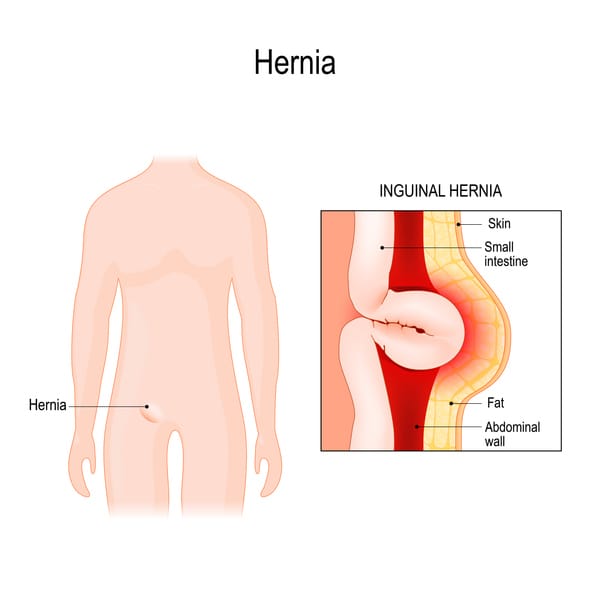
It is much more common in men, who are 8 to 10 times more likely to develop one, but it also occurs in women. You can find more about the condition and how it is treated today on the page about inguinal hernia, as well as in the general section on abdominal wall hernias.
How to tell if you have an inguinal hernia
Many patients have no symptoms in the early stages and notice a small swelling in the groin by chance. In others, the symptoms are clearer. The most typical signs are:
A lump in the groin
The most typical sign is a swelling that appears or gets bigger when you stand, cough or lift something heavy, and often gets smaller or disappears when you lie down. Many people describe it as a small “egg” or “balloon” that comes and goes. In men, the hernia can sometimes move down into the scrotum, causing pain and swelling around the testicles.
Pain, burning or a feeling of heaviness
The swelling often comes with mild or more severe pain, burning or a feeling of heaviness and pulling in the groin. The pain gets worse with coughing, physical exercise, standing for a long time or bowel movements.
Discomfort without a visible lump
In some cases there is no visible swelling and the hernia is noticed only because of pain or pulling. The diagnosis then needs a clinical examination by a surgeon and, where necessary, a dynamic ultrasound scan.
Reducible and irreducible hernia
An inguinal hernia can be reducible, which means that its contents go back into place with gentle pressure or when you lie down, or irreducible, when it stays out and does not easily “go back in”.
Reducible hernia
- The contents go back in with gentle pressure or when you lie down
- The swelling “comes and goes” depending on your position and effort
- Needs a planned assessment by a surgeon
Irreducible hernia
- The swelling stays out and does not easily “go back in”
- Has a higher risk of complications
- Needs assessment without delay
Who is more likely to get an inguinal hernia
An inguinal hernia is usually linked to increased pressure inside the abdomen or to weaker connective tissue. It is more common in:
- People who do heavy manual work or lift heavy weights.
- People who do sport professionally.
- People with obesity.
- Women during pregnancy.
- Long-term smokers or people with a chronic cough.
- People with chronic constipation.
When an inguinal hernia becomes dangerous
An inguinal hernia does not go away on its own. If it is left untreated, there is a risk of strangulation: a section of bowel can become trapped inside the hernia, its blood supply can be cut off and a bowel obstruction (ileus) can develop. This is an emergency that needs immediate surgical treatment.
Seek medical help immediately or go to an Emergency Department if:
- The pain in your groin becomes suddenly severe, constant or “tight”.
- The swelling turns hard, gets bigger and does not go back in as it did before.
- The skin over the hernia becomes red or warm.
- You also have nausea, vomiting or a swollen abdomen, or you cannot pass wind or stools.
- You have a fever or feel very unwell together with the above.
Even without warning signs, early assessment is important: a planned repair is technically easier and safer than an emergency operation. In abdominal emergencies, assessment by an emergency surgery team should not be delayed.
The difference from a femoral hernia
Pain or swelling in the groin, especially in women, can also be caused by a femoral hernia, a hernia that appears slightly lower down. Telling them apart matters, because a femoral hernia is more likely to strangulate and is often treated more actively, even when the symptoms are mild. This is why assessment by a surgeon experienced in hernias is important.
How it is diagnosed

In most cases, an inguinal hernia is diagnosed by a clinical examination by the surgeon and a medical history. The doctor assesses the size, position and behaviour of the hernia, that is, whether it appears when you stand up or cough and whether it goes back in easily.
- Clinical examination and history: the main method, which in most cases is enough for the diagnosis.
- Dynamic ultrasound of the groin: when the hernia is small, at an early stage or not easy to see.
- CT scan: in selected, more complex cases.
When surgery is needed and what the options are
The definitive treatment for an inguinal hernia is surgery. Surgery is usually recommended when:
- There is pain or discomfort.
- The lump is getting bigger.
- The hernia is becoming harder to push back in.
- Your daily life is affected.
The aim of the operation is to put the abdominal contents back in place and strengthen the weak point, usually with a mesh.
Why are support belts or exercises not enough?
An inguinal hernia is an anatomical defect in the abdominal wall, which is why it cannot be corrected with medicines, belts or exercises. A special support belt (truss) can relieve the symptoms for a while, but it does not close the defect. For very small hernias without symptoms, simple monitoring with regular reassessment by the surgeon can be discussed.
Today the repair is often done with minimally invasive methods, laparoscopic or robotic surgery, which offer small incisions, less pain after the operation and a quicker return to moving around. The technique is chosen individually, depending on the type of hernia, the medical history and the patient’s needs.
Dr. Konstantinidis uses advanced robotic techniques for hernia repair, even in more complex or recurrent cases. See the method for laparoscopic repair of abdominal wall hernias in detail, as well as the guide to treatment and recovery after inguinal hernia surgery.
Frequently asked questions
How do I know if I have an inguinal hernia?
The most common sign is a lump or swelling in the groin that appears or gets bigger when you stand, cough or lift something heavy and often gets smaller when you lie down. It may come with pain, burning or a feeling of heaviness. The diagnosis is confirmed by a clinical examination by a surgeon.
Is an inguinal hernia always painful?
No. Many patients, especially in the early stages, have no pain and simply notice a small swelling or mild discomfort. Others have pain, burning or pulling that gets worse with effort, coughing or standing for a long time.
When is an inguinal hernia dangerous?
It becomes an emergency when the swelling turns hard and does not go back in, or when there is severe and constant pain, redness, nausea, vomiting or fever, or when you cannot pass wind or stools. These may be signs of strangulation and need immediate surgical assessment.
Can an inguinal hernia be treated without surgery?
Not permanently. An inguinal hernia cannot be corrected with medicines, belts or exercises, because it is an anatomical defect in the abdominal wall. For very small hernias without symptoms, monitoring can be discussed, but the definitive solution is surgical repair.
Do only men get inguinal hernias?
No. They are much more common in men, but they also occur in women. In women, particular care is needed, because a swelling or pain in the groin may also be linked to a femoral hernia, which has a higher risk of strangulation.
Which test is needed for the diagnosis?
In most cases, a clinical examination by a surgeon is enough. When the hernia is small, at an early stage or not easy to see, a dynamic ultrasound of the groin may be needed, while in selected, more complex cases a CT scan is requested.

Dr. Konstantinos M. Konstantinidis
General Surgeon · MD, PhD, FACS, MAMSE, FASMBS
Dr. Konstantinidis is an internationally recognised General Surgeon, the founder of robotic surgery in Greece, where he was the first to use the da Vinci system in 2006, and a pioneer of laparoscopic surgery. He has long experience in the repair of abdominal wall hernias, with modern techniques that aim at patient safety, less pain after surgery and a quick return to daily life.
If you notice a swelling, heaviness or pain in your groin, a personalised assessment can tell you safely whether you need treatment and which method is right for you.
Sources
- NHS, Inguinal hernia repair. https://www.nhs.uk/tests-and-treatments/inguinal-hernia-repair/
- Mayo Clinic, Inguinal hernia - Symptoms & causes. https://www.mayoclinic.org/diseases-conditions/inguinal-hernia/symptoms-causes/syc-20351547
- Mayo Clinic, Inguinal hernia - Diagnosis & treatment. https://www.mayoclinic.org/diseases-conditions/inguinal-hernia/diagnosis-treatment/drc-20351553
- Cleveland Clinic, Inguinal hernia. https://my.clevelandclinic.org/health/diseases/16266-inguinal-hernia
- NIDDK (NIH), Inguinal hernia. https://www.niddk.nih.gov/health-information/digestive-diseases/inguinal-hernia
This article is for information only and does not replace individual medical assessment, diagnosis or treatment. For any symptom, consult your doctor.

Why choose Dr. Konstantinidis?
Dr. K. M. Konstantinidis and his team possess vast experience in the field of laparoscopic and robotic surgery.
Dr. Konstantinidis is the pioneer of Robotic Surgery in Greece and one of the leading figures internationally in the field. He has performed the largest series of General Surgery operations in Europe with the innovative Da Vinci® robotic system.