


Cholelithiasis (Gallstones)
Cholelithiasis, commonly known as gallstones, is a condition that, when accompanied by symptoms, is dangerous and requires urgent surgical treatment with cholecystectomy.
That is why the gallbladder is often removed proactively after gallstones have been identified.
Cholecystectomy is considered a common procedure; however, it is performed in a part of the body with particular anatomical features and as a result it is considered technically demanding. The particularity of the area means that complications from the operation can be potentially dangerous.
Dr. Konstantinidis and his Surgical Team have many years of experience and specialization in performing robotic cholecystectomy operations through a single incision (single site technique) in order to ensure the optimal medical and cosmetic outcome for each patient.

What is the gallbladder?
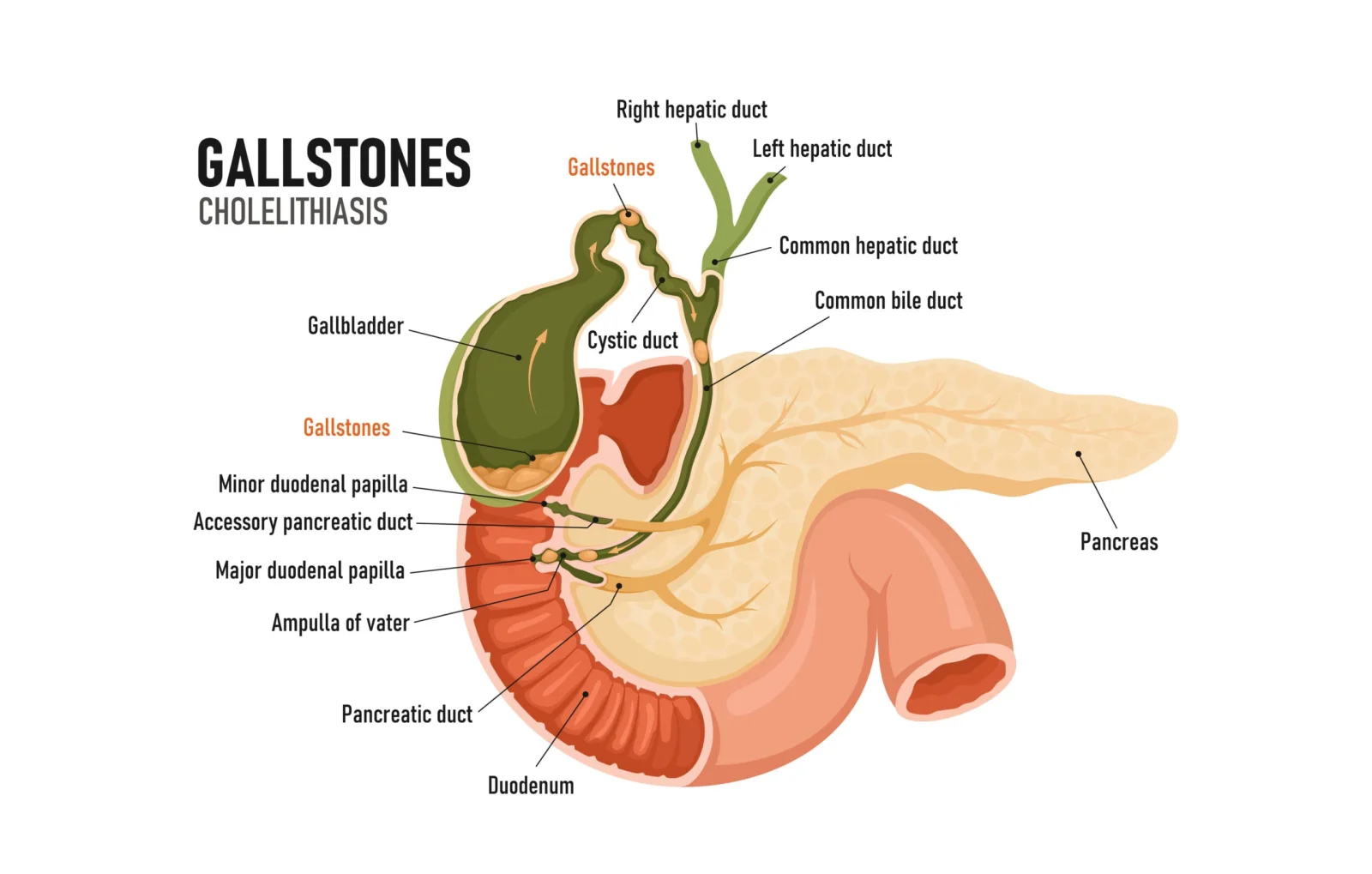
The gallbladder is a pear-shaped organ located below the right side of the liver.
Its main function is to collect part of the digestive fluid (bile) produced by the liver.
This fluid is released from the gallbladder after eating, when needed, thus facilitating the digestion of mainly fatty substances. The bile flows through narrow tubular canals (bile duct) into the small intestine.
What is Cholelithiasis (Gallstones)?
Cholelithiasis refers to the formation of cholesterol and bile stones in the gallbladder.

Do you want to know more about Cholelithiasis?
Why choose Dr. Konstantinidis?
Dr. K. M. Konstantinidis and his team possess vast experience in the field of laparoscopic and robotic surgery.
Dr. Konstantinidis is the pioneer of Robotic Surgery in Greece and one of the leading figures internationally in the field. He has performed the largest series of General Surgery operations in Europe with the innovative Da Vinci® robotic system.
What are the symptoms of Gallstones?

If these stones advance into the bile duct, they block the flow of bile out of the gallbladder and cause cholecystitis, an inflammation of the gallbladder, which results in acute abdominal pain, vomiting, indigestion and in some cases fever.
Cholecystitis is the most common complication of cholelithiasis and the most common cause of cholecystectomy.
In addition, if gallstones block the common bile duct, that may cause jaundice (yellowing of the skin) or pancreatitis.


What are the causes of Gallstones?
The causes of gallstones are not known, so there are no ways to prevent their formation. However, they have been linked to the following risk factors:
- Advanced age
- Obesity
- Diabetes
- Hyperlipidemia
- Multiple pregnancies
- Use of contraceptives
- Crohn’s disease
- Ileal resection
- Cirrhosis
- Cystic fibrosis
- Hemolysis
Gallbladder polyps are also associated with the formation of gallstones, while a history of gallstones is one of the risk factors for biliary cancer.
How is Cholelithiasis diagnosed?
The presence of gallstones may be accompanied by symptoms (acute abdominal pain, vomiting, indigestion, bloating, etc.) but is often asymptomatic.
The safest, most painless and cost-effective method of diagnosis is ultrasonography.
How is Cholelithiasis treated?
Usually, gallstones have no symptoms, do not cause pain, and therefore do not require treatment other than regular monitoring.
However, because they can cause symptoms in the future and result in cholecystitis, when the patient is over 50 years old, surgical removal of the gallbladder is recommended, as a precaution and in order to avoid surgery in the future under potentially less favorable health conditions.
Even at a younger age, however, preventive removal of the gallbladder is often recommended, despite the absence of symptoms.
When cholelithiasis causes symptoms and cholecystitis, surgical removal of the gallbladder is the most appropriate and safest treatment.
Cholecystectomy is the surgery of choice for gallbladder removal and treatment of cholelithiasis.
Cholecystectomy can be performed with conventional open surgery, which is gradually being abandoned as it involves a large incision, or with minimally invasive techniques, such as traditional laparoscopy, which is performed through 4 holes in the patient’s abdomen, or robotic surgery which is the evolution of laparoscopy, entailing just a single 1.5 cm incision.
Cholecystectomy with Exploration of the Cystic Duct
What is Laparoscopic Cholecystectomy?
Classical laparoscopy for cholecystectomy requires 4 incisions through which all the necessary tools, as well as the special camera, are inserted into the abdomen.
This is considered a routine operation, but in reality it is quite demanding, as the anatomy of the biliary region has many particularities that vary from patient to patient.
Complications are rare, but when they do occur they are serious.
Therefore, it is good for the surgeon to have extensive experience and knowledge of the anatomy of the area.
What is Robotic Cholecystectomy?
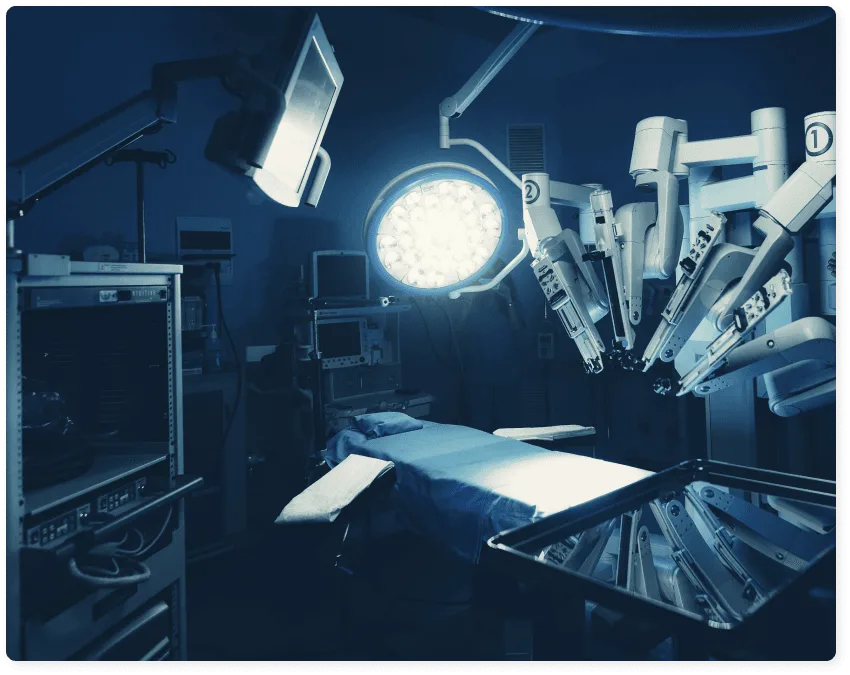
Robotic surgery is the evolution of laparoscopy and as such, it takes the advantages of laparoscopy as a minimally invasive method even further (faster recovery, less postoperative pain, optimal aesthetic result), while eliminating its weaknesses.
The arms of the surgical robot, which are controlled by the surgeon through a console, have far greater accuracy, flexibility and stability in their movements compared to the human hand.
As a result, the following is achieved simultaneously:
- minimal risk of unnecessary injury to neighboring tissues and organs, such as the bile ducts, the liver, and the spleen
- access to even the most inaccessible anatomical areas so that the entire operation can be performed through a micro-incision in the navel (single site robotic cholecystectomy)
What is Single-Site Robotic Cholecystectomy?
Athens Medical Center and the Robotic Surgery team of Dr. Konstantinidis were selected along with two other centers internationally, one in Italy and one in Switzerland, to simultaneously begin the application of state-of-the-art Single-Site Robotic technology.
With this technique, Robotic Cholecystectomy is carried out entirely through a single 1.5 cm incision in the navel.
The average duration of the operation is 40 minutes.
Single site surgery is not new. With conventional laparoscopic tools it poses great technical difficulty because all the tools are operated in the same straight line. Thanks to Robotics, angulation problems are solved and the surgeon regains the feeling of operating normally.
Particularly in Single-Site Robotic Cholecystectomy, the flexible tools cross at the entry point and the system electronically reverses the arms (the right becomes the left one and the left the right one) so that the surgeon’s movements are comfortable and natural.
Minimizing surgical trauma eliminates postoperative discomfort for the patient and shortens recovery. With a single incision, the postoperative course of patients improves significantly, with fewer incision-related problems and an excellent cosmetic result.
Last updated:
